The Indian Rupees Trading At 95.2425 Against The Dollar
Share




Financial Market Overview
USDINR
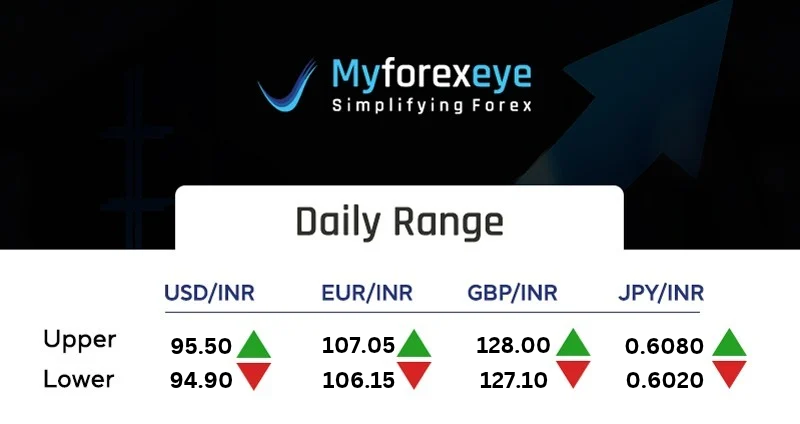
The Indian rupee opened at 95.2150 against the U.S. dollar on Friday, compared to its previous close of 95.26 on Thursday. Indian rupee rose 7 paise to trade at 95.19 against the US dollar in early interbank transactions, supported by a weakening greenback at 101.75 and falling US treasury yields. Despite a brief touch at 95.19 after opening at 95.21, sharp gains were limited due to a surge in crude oil prices, weak Asian markets, and continued Foreign Institutional Investor (FII) equity outflows. Supported by positive momentum in the domestic equity market, with the Sensex up 138.77 points and Nifty rising 38.95 points, analysts expect the currency to operate within a 94.75 to 95.75 range, though the IMF advised that exchange rate flexibility, rather than heavy RBI intervention, should serve as the primary buffer against ongoing external energy shocks.
United States 10-Year rates were 4.923% on the bond markets, while 2-year Treasury yields were 4.575%. The DXY index trading around 102.82.
At the time of writing, USDINR was trading at 95.2425/95.2525.
GBPUSD
GBP/USD pair gained traction to trade near 1.3380 during Friday's early European session, supported by market digestion of the UK Autumn Budget and Bank of England rate expectations, yet it retains a near-term bearish outlook while capped below its 100-day simple moving average. The UK's newly set target to raise defense spending to 3% of GDP by 2030 and a modestly tighter budget structure are viewed by analysts as fiscal moves that leave the BoE's higher-for-longer policy trajectory largely intact, further reinforced by hawkish remarks from BoE official Greene regarding stalled wage disinflation. Meanwhile, US rate expectations remain elevated following a 0.5% rise in the September PCE Price Index, leading markets to price in a nearly 75% chance of a Federal Reserve rate hike in December after holding rates steady at 3.75% to 4%. From a technical perspective, resistance sits around the 1.3390–1.3400 zone, while the 20-day Bollinger middle band at 1.3300 serves as primary downside support.
At the time of writing, the GBPUSD was trading at 1.3397/1.3398.
EURUSD
EUR/USD stabilized near 1.1190 following the European Central Bank’s decision to hold its deposit rate steady at 2.50%. Rising energy costs pose upside risks to Eurozone inflation, leading money markets to price in a 67% chance of a December rate hike, though analysts expect policymakers to ultimately hold rates while maintaining a measured stance. Technically, the pair retains a overall bearish bias below its 100-day simple moving average and the 1.1200 immediate resistance mark, with key support holding at the lower Bollinger Band of 1.1135 and 1.1113. Market focus now shifts to incoming German and Eurozone preliminary Q3 GDP data to determine whether the Euro can break past resistance or test lower support levels.
At the time of writing, the EURUSD was trading at 1.1185/1.1186.
USDJPY
The Bank of Japan (BoJ) held its policy rate steady at 1.25% in an 8-1 vote, delivering a hawkish pause as hot Tokyo CPI data and upside inflation risks reinforced market bets for an imminent December rate hike. Consequently, the USD/JPY pair extended its decline below mid-157.00s for a third consecutive day, further pressured by a weakening US Dollar amid US-Iran diplomatic efforts and declining US bond yields that narrowed the US-Japan rate differential. While the overall macro backdrop continues to favor further downside for the currency pair, traders are holding off on aggressive positioning ahead of BoJ Governor Kazuo Ueda's post-meeting press conference for further direction.
At the time of writing, the USDJPY was trading at 157.56/157.57.
Share

Recent Blog



Ready to make smarter forex decisions?
Get timely market updates straight to your inbox and WhatsApp.