Monthly Outlook - January 2026
Share





MONTHLY OUTLOOK
USDINR Fundamental
The rupee fell by around 4.9% this year with an uneven December, shaped mainly by external pressures and strong central bank action. During the month, the rupee slipped to a record low near 91.08 before recovering sharply on RBI intervention and ending December at 89.87. Persistent FII’s outflows, strong importer demand for dollars, and ongoing uncertainty around the U.S.–India trade agreement remained the main sources of pressure. Foreign investors continued heavy selling, with equity outflows crossing $18 billion in 2025, limiting dollar inflows. Interest rate cut to 5.25% & trade-related concerns also weighed on sentiment. While trade deficit narrowed to -24.53B and PMI & GDP showed steady economic growth, these positives didn’t provide much support to the currency. The RBI played a key role in stabilizing the rupee. Strong intervention helped curb speculative pressure, while liquidity measures such as ?2T OMO operations and $10B FX swap auctions eased stress in the forward market. Rising foreign exchange reserves to around $693 billion also strengthened the RBI’s ability to manage sharp currency moves in future.
Globally, the U.S. dollar fell by around 9% annually, marking its biggest fall since 2017. It softened despite strong U.S. GDP growth, as signs of cooling inflation, slower job growth, and expectations of interest rate cuts in 2026 weighed on the dollar. Also, the dollar stayed weak after the Fed announced it would support markets by buying $40B of U.S. Treasury bonds each month, adding more liquidity to the system. Looking ahead, USDINR is expected to stay on the higher side in the coming month. Continued RBI support should limit sharp weakness, but persistent dollar demand, foreign outflows, and trade uncertainty are likely to restrict any strong recovery. The rupee may remain mildly weak, with movements largely guided by central bank actions and global developments.
USDINR Technical
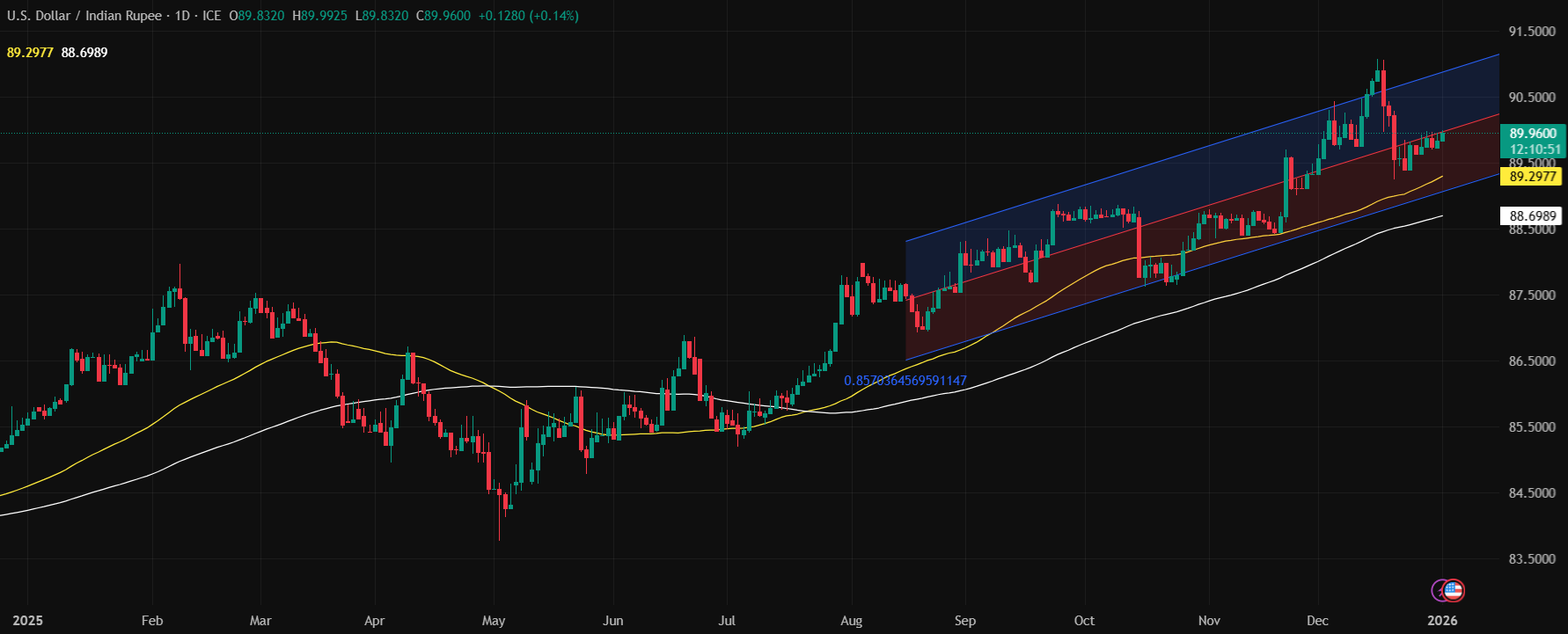
The Indian rupee weakened by nearly 5% in 2025, starting the year at 85.62 and ending around 89.87. The rupee saw a strong recovery in December after touching an all-time high of 91.08 on 16 December. This recovery was entirely driven by central bank intervention, aimed at curbing a one-sided move in the currency. While the dollar–rupee pair gained close to 5%, the Dollar Index declined by nearly 7% over the same period, highlighting a clear divergence between the two.
From a technical perspective, the daily chart shows a sustained uptrend throughout 2025, except for one corrective phase in May. As per the linear regression channel, the bullish bias continues, suggesting the possibility of further upside. Currently, the pair is positioned near the middle of the regression channel. On the upside, the 90.25–90.50 zone is expected to act as initial resistance, while on the downside, the 50-day SMA (yellow line) followed by the 100-day SMA (white line) is likely to provide strong support.
In 2025, many market participants have come to accept that markets are dynamic and can move unexpectedly at any time. To manage such uncertainty, hedging remains essential. At present, a combination of options and forwards is recommended. Importers are advised to continue hedging on dips, while exporters may consider hedging only above the 90 level.
EURUSD Fundamental
EURUSD pair continued its uptrend reaching highest to 1.1802 near the highest levels since September. Feds softer outlook and its $40 billion T-bill liquidity plan made market think policy will stay easy, which kept the dollar under pressure. The Eurozone showed better economic strength as the inflation moved to 2.2% close to ECB’s target. The growth data and surveys also came in better than expected. At its December 18 meeting, the ECB kept interest rates unchanged and raised its growth and inflation forecasts. ECB President Christine Lagarde said policy decisions would depend on incoming data, and some officials suggested the next move could even be a rate hike if the economy stays strong, which supported the EUR.
In U.S, unemployment rose to 4.6%, its highest level in several years. While job growth has moderated and unemployment has moved higher, showing softer labour market which increased bets for more rate cuts by the fed in 2026, helped EURUSD move moderately higher. In the near term, further comments from the Fed and the ECB, also the Russian –Ukraine peace deal might influence the pair’s further direction.
EURUSD Technical
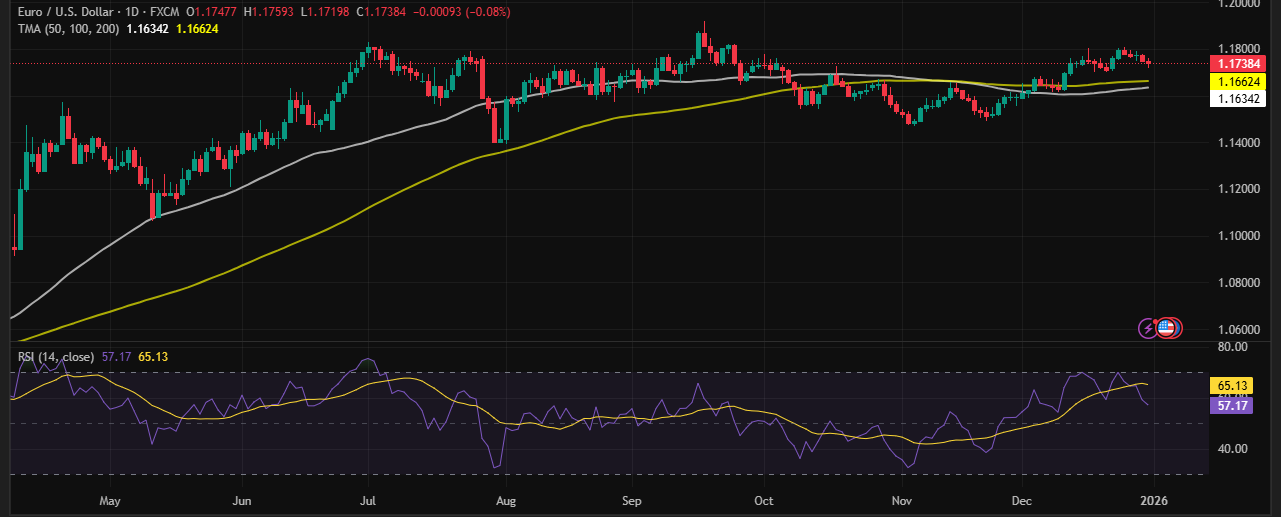
EURUSD opened the month at 1.1609 and closed higher at 1.1738. Throughout December, the pair successfully transitioned from a recovery phase into a sustained uptrend. After breaking above the psychological 1.1700 resistance level in the second week of the month, the pair hit an intra-month high of 1.1807 before entering a healthy period of year-end consolidation. The pair finished the month (and the year) at 1.1732, marking an annual gain of over 11%. From a technical standpoint, the outlook for January remains constructive. The price action has successfully integrated above the 50-day and 100-day SMA. The 14-day RSI is currently at 57, down from mid-month peaks of 69, suggesting that the pair has cooled off from near-overbought conditions and now has room for another leg higher. The 1.1800 level remains a key psychological resistance and has consistently capped rallies, reinforcing its role as a strong ceiling, while a break above this could open the doors to the psychological 1.1900 barrier. On the downside, the 100-day SMA 1.1662 has now flipped into a support level.
GBPUSD Fundamental
GBP ends the year with around 7% gain after a steady recovery through December, driven mainly by Dollar weakness and relatively stable U.K. policy signals. The pound benefited as markets increasingly priced in further easing by the Fed, following mixed U.S. economic data that showed slowing inflation and signs of cooling in the labour market. Although U.S. GDP growth remained strong, softer consumer confidence and cautious Fed guidance kept the dollar under pressure. The BoE delivered a widely expected rate cut in December to 3.75%, which had limited negative impact on sterling as it was largely priced in. Policymakers signaled a gradual approach to future easing, noting that inflation, while easing, remains above target. U.K. data remained mixed, with weak GDP growth contrasting with falling inflation, keeping expectations of further but measured rate cuts intact. The Budget also helped support confidence by improving the fiscal outlook and raising growth projections. Looking ahead, GBPUSD may remain supported if U.S. dollar softness continues and markets maintain expectations of Fed easing. However, weak U.K. growth and the possibility of additional BoE rate cuts could limit further upside, keeping gains gradual rather than aggressive.
GBPUSD Technical
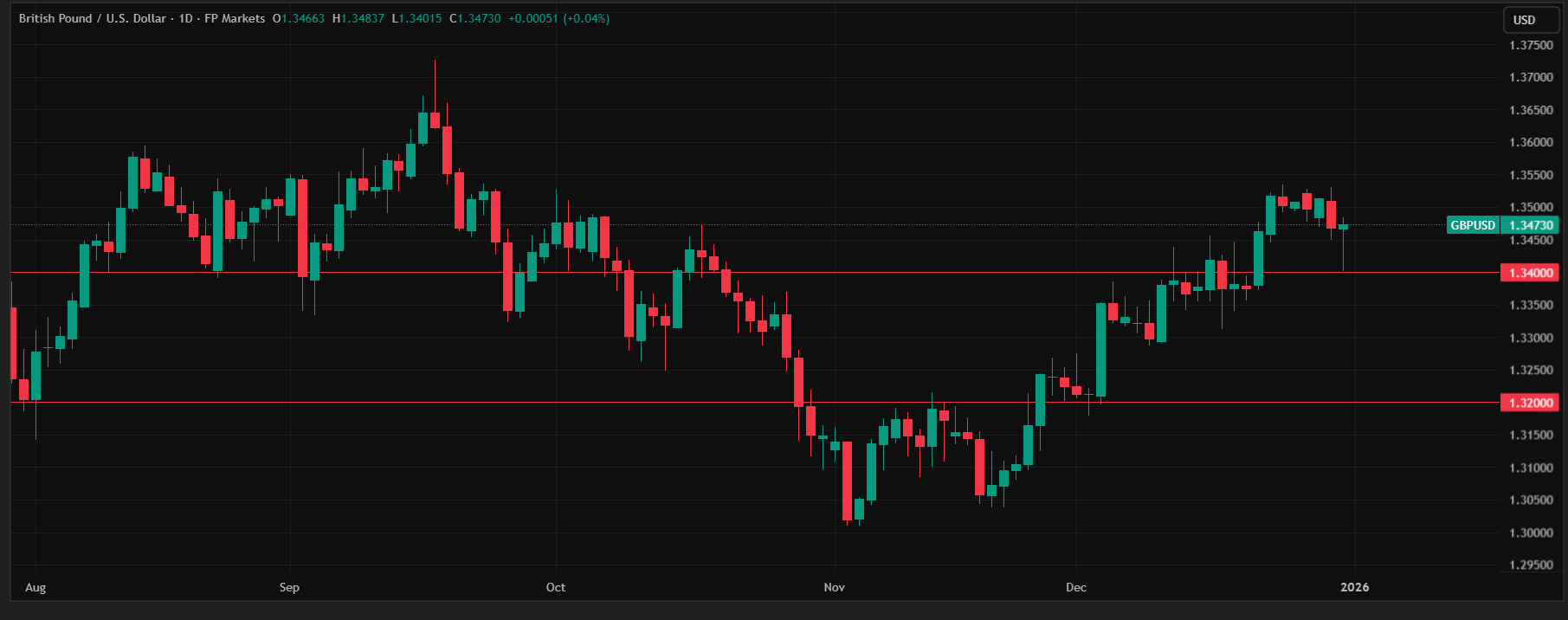
GBPUSD delivered a strong performance over the month, rebounding firmly from the key support at 1.3200 early in the period and rallying to an almost two-month high of 1.3534. The pair maintained a bullish tone throughout the month, reflecting sustained buying interest and supportive broader market conditions. The overall technical outlook remains constructive, with near-term support seen just below 1.3400, a level likely to be pivotal in the weeks ahead. Expectations of U.S. interest-rate cuts in 2026, along with the approaching end of Federal Reserve Chair Jerome Powell’s term in May, continue to weigh on the dollar and lend underlying support to the pair. On the upside, the 1.3500–1.3600 zone stands out as immediate resistance, and a decisive break above this area could reinforce bullish momentum and open room for further gains. From a hedging perspective, exporters are advised to begin hedging gradually and scale up hedge ratios on rallies, while importers may look to utilize pullbacks toward the 1.3400 region for near-term hedging opportunities.
USDJPY Fundamental
USDJPY traded largely within the 154.34–157.76 range, with movements driven mainly by central bank actions and shifting policy expectations. Early in the month, the dollar strengthened as markets expected the U.S. Federal Reserve to remain relatively hawkish, while the yen weakened alongside rising U.S. bond yields, pushing the pair toward the upper end of the range.
The Fed later cut interest rates by 25bps but clearly signaled that only one additional rate cut is likely in 2026. This guidance led to a decline in U.S. yields and some softening in the dollar, pulling USDJPY back toward the lower end of its monthly range. U.S. economic data sent mixed signals, with job growth remaining modest and the unemployment rate rising to 4.6%, the highest level in several years, reinforcing expectations of gradual Fed easing next year.
In Japan, inflation remained above the BOJ’s target while growth and business sentiment stayed stable. The BOJ raised rates to 0.75% but sounded cautious, weakening the yen and lifting USDJPY above 157 levels. Subsequent intervention warnings helped limit further yen losses, Looking ahead, Fed guidance and BOJ’s intervention stance might shape near-term direction.
USDJPY Technical
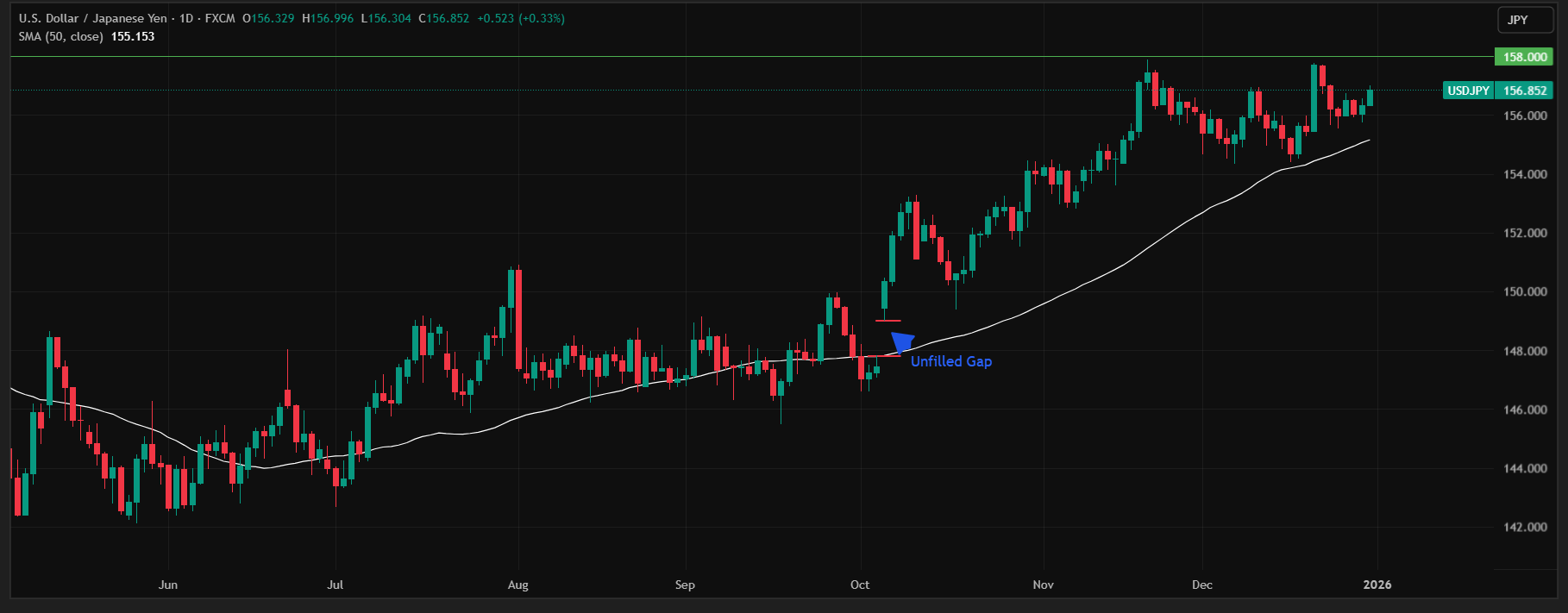
USDJPY recorded a broadly positive performance during December, opening the month near 155 and advancing steadily to a monthly peak of 157.76 before easing slightly to close around 156.85. The unfilled upside gap from October, created following the appointment of Japan’s new prime minister and spanning 147.82–149.00, continues to stand out as a key medium-term technical zone and would likely attract attention as a potential support area on any deeper retracement. From a technical perspective, the 50-day simple moving average near 155 provides strong near-term support, while the 157–158 zone remains an immediate resistance area. Growing expectations of policy normalization at upcoming Bank of Japan meetings could lend support to the yen, potentially pulling the pair toward the 100-day SMA near 152, which represents an important downside level. Nevertheless, USDJPY remains underpinned by the wide U.S.–Japan yield differential. While the broader bias favors gradual yen appreciation, traders should remain alert to short-term corrective moves amid stretched positioning and expectations of U.S. rate cuts in 2026, alongside the approaching end of Chair Powell’s term in May.
Share

Recent Blog



Ready to make smarter forex decisions?
Get timely market updates straight to your inbox and WhatsApp.