Indian Rupee Finished The Day at 90.7000
Share




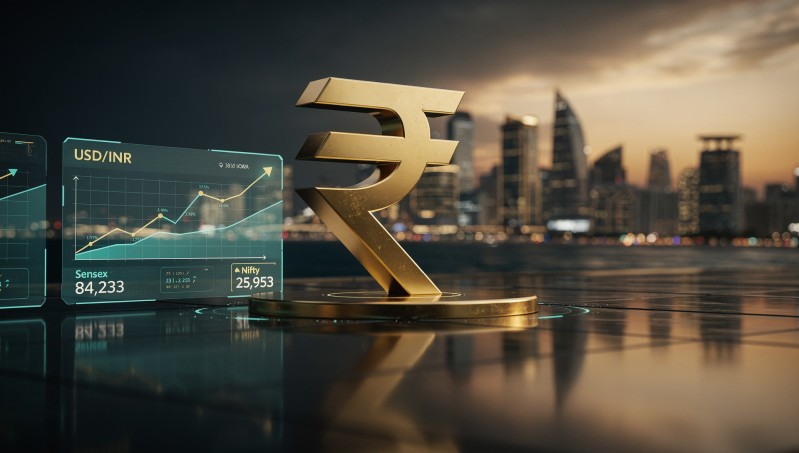
The Indian rupee closed at 90.7000 on Wednesday in comparison to its previous closing at 90.5700 on Tuesday evening. The Indian rupee weakened slightly in late trading on Wednesday, closing at 90.70 against the US dollar, down 0.1% from the previous session's close. The decline was driven by increased dollar demand from foreign banks, likely representing custodial clients, despite earlier mixed corporate flows keeping the currency stable. In a generally subdued session, the rupee underperformed compared to other Asian currencies, which gained 0.1% to 0.5% amid a broadly softer dollar (with the dollar index at 96.5, down about 1% this month). Indian equity benchmarks like the Sensex and Nifty 50 showed little movement, while market attention turned to the delayed US January jobs report, due later that day, with expectations of around 70,000 nonfarm payroll additions and a steady 4.4% unemployment rate—potentially influencing dollar strength and rate-cut pricing (currently at 40% odds for April). Meanwhile, local swap markets suggest the Reserve Bank of India's rate-cutting cycle may have concluded.
At close, the Sensex was down 40.28 points or 0.05 percent at 84,233.64, and the Nifty was up 18.70 points or 0.07 percent at 25,953.85. Eicher Motors, Apollo Hospitals, Max Healthcare, SBI, Maruti Suzuki were among major gainers on the Nifty, while losers included Coal India, TCS, HCL Technologies, Eternal, Infosys.
Indian equity markets closed nearly flat in a volatile, range-bound session, with the Sensex ending marginally lower at 84,233.64 (down 0.05%) and the Nifty closing slightly higher at 25,953.85 (up 0.07%). Trading remained lacklustre after recent gains, as mixed sectoral performance limited overall momentum: the auto index surged 1.3%, PSU banks and pharma rose around 1% each, and consumer durables gained modestly, while the IT sector slumped 1.7% amid global pressures and weak US economic cues. Key outperformers included Eicher Motors, Apollo Hospitals, Max Healthcare, SBI, and Maruti Suzuki, whereas Coal India, TCS, HCL Technologies, Eternal, and Infosys were notable laggards. Broader midcap and smallcap indices ended flat, with over 120 stocks hitting 52-week highs despite cautious sentiment influenced by Q3 earnings, ongoing FII flows, the BHEL OFS, and global trade developments such as the US-Bangladesh agreement impacting textiles. Analysts expect short-term consolidation but maintain a positive medium-term outlook, favoring selective stock picking in autos, pharma, consumption, and quality midcaps while avoiding IT weakness.
Share

Recent Blog



Ready to make smarter forex decisions?
Get timely market updates straight to your inbox and WhatsApp.